
The Goa Foundation and the Amche Mollem campaign welcome the Regional Empowered Committee’s rejection (26.3.2026) of Goa govt’s request to restore forest clearances held in abeyance by the central government since 2022.
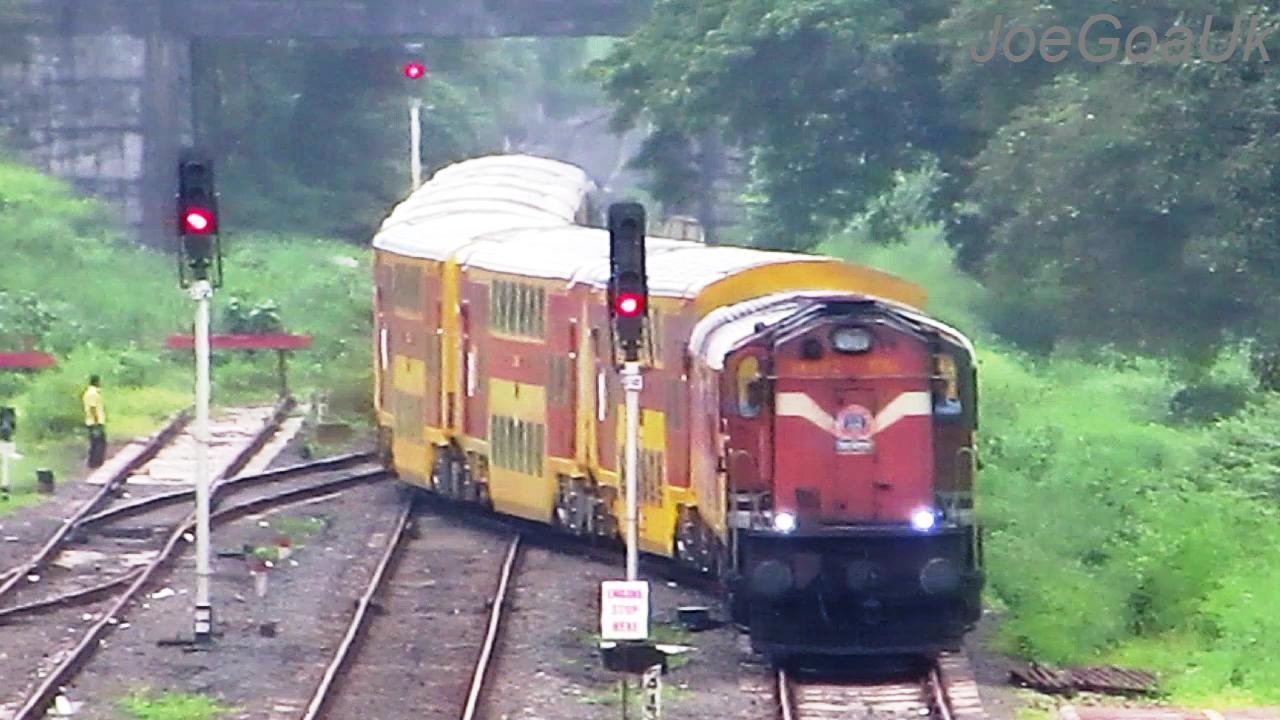
The South Western Railway (SWR) has been pushing a controversial and wholly destructive proposal for doubling its railway line through the Bhagwan Mahaveer Wildlife Sanctuary and National Park from Castle Rock to Kulem. The proposal was given wildlife clearance by the Standing Committee of the National Board of Wildlife (NBWL). After the Goa Foundation approached the Central Empowered Committee (CEC), the CEC recommended cancellation of the wildlife clearance. This recommendation was accepted by the Supreme Court by a detailed order dated 9.5.2022. Thereafter, all the forest clearances issued for the railway track in the wildlife sanctuary and national park were held in abeyance by an order of the MOEF&CC on 30.05.2022.
The Goa Government has attempted several times, on behalf of the SWR and Railway Vikas Nigam Limited (RVNL), to get the abeyance order vacated. The REC’s rejection of the request is the third such rejection of the proposal.
The wildlife groups and the Goa Foundation are thoroughly appalled by the anti-wildlilfe and anti-forest attitude of the Goa government and its forest department. It is interesting to note that the Karnataka forest department has taken a contrary view and refused to grant approval for the same project falling within Karnataka’s Protected Areas.
The following facts are being brought to the attention of the press:
1. The REC in its meeting on 26th March 2026 deferred the state government/ RVNL’s request for revocation of the abeyance order for the forest clearances granted to the railways for the Kulem-Kalem section (15.6077 ha). It may be recalled that in 2022, the Supreme Court struck down the wildlife clearance granted by the National Board for Wildlife on the recommendation of the CEC. As a result, the MOEF passed an order on 30.05.2022, keeping the forest clearance granted to the project in abeyance. This left the forest clearances in a state of suspension. Since that time, the state government has made multiple attempts to get this order revoked for different stretches of the Hospet-Tinaighat-Castlerock-Kulem-Vasco railway doubling project in favour of Rail Vikas Nigam Ltd. This is the third time that the request has come up for the Kulem to Kalem section alone.
2. In its meeting, the REC once again reiterated its stance that the railway line cannot be broken up into separate stretches for the purpose of obtaining such clearances and that even though the Supreme Court order did not explicitly include Kulem-Kalem section, the operative part of Hon’ble Supreme court judgement has to be read ‘in its spirit’ to include this section which is also a part of Bhagwan Mahavir Wildlife Sanctuary. The REC also noted that the same request involving diversion of forest land along the Kulem-Kalem section was not recommended in its previous meeting due to the fact that said stretch falls in Bhagavan Mahaveer Sanctuary and in the Eco-sensitive Zone (ESZ) of Bhagawan Mahaveer Sanctuary. The Goa forest department had informed the REC that there is not much difference with respect to ecological diversity between the Castle Rock-Kulem section and Kulem-Kalem section.
3. Now the State Government vide its letter 17.02.2026 once again forwarded RVNL’s request for revocation of the abeyance order. This time, it included a copy of the ‘cumulative impact assessment’ report of the proposed Kulem-Kalem section carried out by the Wildlife institute of India (WII), Dehradun and has also submitted a future traffic study report undertaken by RITES. The REC has flagged the WII EIA for its critical shortcomings and its lack of rigour and observed that the WII EIA has restricted itself to merely recommending mitigation measures, rather than carrying out a comprehensive and rigorous assessment of ecological impacts of the project within the Protected Areas.
4. It is worth noting that the RVNL paid a sum of Rs. 4.7 crores to the WII (one govt agency to another) to complete this EIA. WII is in fact an agency of the Ministry of Environment, Forest and Climate Change (MOEF&CC). Despite this, and claims of being more comprehensive, the WII EIA repeats many shortcomings of the previous EIA done by IISc. The EIA entirely excludes fungi, insects, arachnids and freshwater fish from its assessment. The methods used to study other wildlife species lack scientific rigour including species misidentification and biased sampling methods, as shown by the Amche Mollem campaign over the past few weeks through our social media channels. The EIA did not include the social impacts of the railway project, in spite of widespread public opposition to the project.
5. Additionally, the EIA is not a comprehensive study of environmental impact, but rather a limited Biodiversity Impact Assessment (BIA) only. But even as a BIA, the document is not holistic in incorporating the bare minimum number of indicator faunal taxa. The report fails to report the landscape’s ecological functions, including its role as a tiger and elephant corridor, and omits discussions of habitat connectivity and ecosystem services. The most important omission is the absence of documenting and understanding the impacts on freshwater fishes and odonates.
6. Referring to the flora section, the WII EIA itself comes to the damaging conclusion that “even with a well-planned and successfully executed restoration project, it may not be possible to completely recover the biodiversity value lost because of the construction of the new alignment.”
7. Should a new proposal/ EIA be produced, we underscore the REC’s stance that the document should first be submitted to the NBWL/CEC before it comes to the REC – which deals with forest clearances. However, having spent Rs.4.7 crores on its second attempt at submitting an EIA, and having failed to produce a rigorous study once again, and having approached the REC multiple times with no success, we insist that the forest clearances granted to the RVNL be cancelled altogether.
8. We also want to bring to your attention that the railway work has consistently caused problems for people living along the tracks, especially outside the Wildlife Sanctuary/ National Park. Vibrations from the trains have compromised the structural integrity of 130+ socio-cultural sites along the tracks and residents of Vasco have been protesting for years against the transport of coal in the area. We stand with the people of Velsao-Cansaulim-Arossim who have consistently fought this takeover of their land, health and peace for the sake of coal transport. If the railways cannot go through the Bhagwan Mahavir Wildlife Sanctuary and Mollem National Park, we insist that RVNL desist from any further doubling work anywhere in Goa.
Claude Alvares Jerusha D’Souza
Goa Foundation Amche Mollem Campaign