
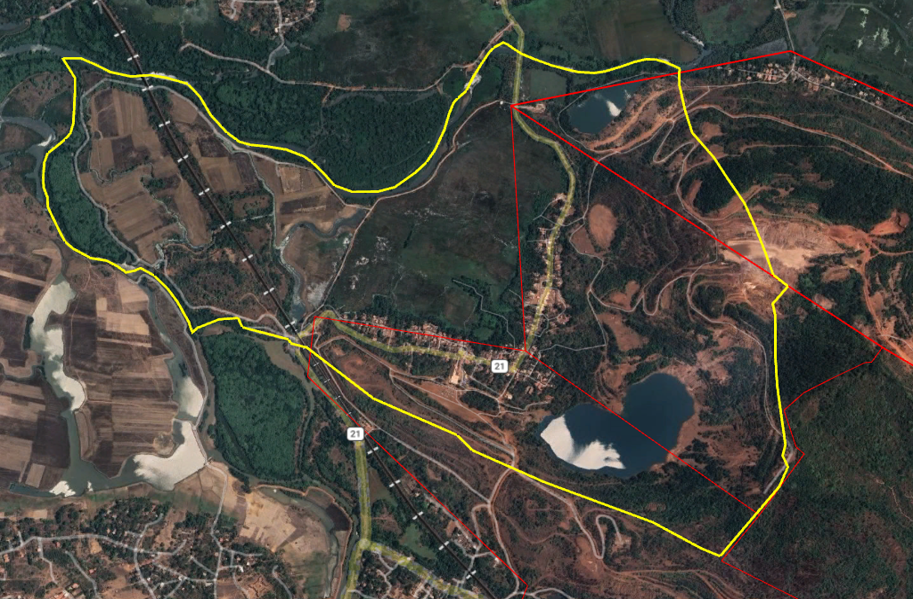
ENVIRONMENTAL APPRAISAL: IMPACT OF IRON ORE MINING ON SIRIGAO VILLAGE, BICHOLIM TALUKA, GOA
Author: Dr Sagar Dhara
South Asia People’s Action on Climate Change (SAPACC)
(This report, completed in September 2026, and being released today, was commissioned by the villagers of Sirigao and took two years to complete. It is the first such study in India to provide financial aspects of ecological and environmental harm generated by mining over 50 years.)
This document presents the findings of a comprehensive environmental and social appraisal of the impact of iron ore mining on the village of Sirigao, Goa. For fifty years, the extraction of iron ore has been the primary economic driver in the region, but this study reveals that the wealth generated has come at an unacceptable cost to the local community.
The appraisal finds that mining activities have fundamentally altered the ecology of Sirigao, leading to the contamination of water and soil with toxic heavy metals, the destruction of traditional agricultural and forest-based livelihoods, and a measurable decline in human health. By quantifying these losses, this report demonstrates that the economic gains of mining companies are dwarfed by the “unpaid” social and environmental debts left to the villagers. This report serves as a formal call for immediate compensation, ecological restoration, and the restoration of community sovereignty through the Gram Sabha.
2. WHY THIS REPORT EXISTS
The natural resources of Sirigao — our water, our soil, and our forests — are not merely “commodities” to be extracted for global markets. They are a shared inheritance. They are a sacred trust passed down by our ancestors, meant to provide security, health, and dignity to every generation.
For fifty years, this trust has been violated. While mining corporations have extracted billions of rupees in wealth, the “externalities” — the toxic dust, the poisoned rivers, and the broken health of our people — have been ignored. The current economic model in Sirigao is built on an injustice: the profits are private, but the destruction is public. This report is not just a collection of data; it is a demand for fairness. It is a demand that the principle of “the polluter pays” finally moves from a legal theory to a lived reality.
3. DETAILED FINDINGS: THE EVIDENCE OF DESTRUCTION
The findings of this report are categorized into four critical areas of impact: Environmental, Economic, Health, and Social.
A. Environmental Contamination (Water and Soil)
The most fundamental impact of mining is the degradation of the village’s life-support systems.
- Toxic Heavy Metals: The report finds that the water and soil in Sirigao have been contaminated with heavy metals. These are not just “impurities”; they are toxic substances that do not disappear.
- Carcinogenic Risks: Many of the metals detected are known to be carcinogenic (cancer-causing). This means the very ground the villagers walk on and the water they drink are now potential sources of long-term illness.
- Loss of Natural Sources: The village has lost its original, clean water sources entirely, forcing residents to rely on external, often expensive, alternatives.
B. The Collapse of Livelihoods (Agricultural and Forest Loss)
Mining has replaced a self-sustaining ecosystem with an industrial wasteland.
- Agricultural Destruction: The loss of fertile land has devastated local farming. The report specifically documents the loss of:
- Paddy (Rice): The staple food of the village.
- Horticulture: Significant losses in Cashew, Coconut, and Mango production.
- Dairying: The loss of grazing lands has crippled local milk production.
- Forest and Fishery Loss: The destruction of the forest has deprived villagers of “Non-Timber Forest Products” (NTFPs) such as timber, firewood, and edible fruits (like Kokum and Tamarind). Furthermore, the runoff from mines has poisoned local water bodies, destroying the traditional fishery.
C. Human Health and Physical Damage
The impact of mining is not just seen in the landscape; it is seen in the bodies of the people and the walls of their homes.
- The Cancer Threat: Based on lifetime exposure to polluted air and water, the report estimates an elevated cancer risk for the population, calculated to be as high as 6,900 to 8,200 per million people.
- Respiratory Issues: There is a documented increase in respiratory illnesses, such as asthma, linked to the inhalation of iron ore dust and air emissions.
- Structural Damage: The physical vibration and environmental changes caused by mining have resulted in visible cracks in the structures of village homes.
D. The Economic Balance Sheet (The Math of Injustice)
The report uses a “Balance Sheet” to compare the wealth taken from the village against the costs left behind.
| Item | Estimated Value | Description |
| Total Wealth Extracted | ₹7,000 Crores | The estimated gross revenue from iron ore sales over 50 years. |
| Direct Human Loss | ₹1,000 Crores | Losses to agriculture, fisheries, water, and physical health/homes. |
| Social Externalities | ₹2,000 Crores | The “unpaid” cost of lost natural productivity (NPP) and CO2 emissions. |
| Restoration Debt | ₹1,000 Crores | The minimum cost required to begin ecological reclamation. |
| TOTAL DEBT | ₹4,000 Crores | The total cost of mining to Sirigao is 60% of the revenue taken. |
4. CONCLUSIONS AND RECOMMENDATIONS
Conclusions
- Unacceptable Damage: The environmental changes in Sirigao are drastic, permanent, and directly attributable to iron ore mining.
- Regulatory Failure: The state and central government agencies have failed in their duty to protect the citizens and the environment.
- A Health Crisis: The village is facing a long-term public health crisis due to heavy metal exposure.
Recommendations
To the Government and the Courts:
- Immediate Safety: Ban the use of local water and homegrown food until independent testing proves they are safe.
- Mandatory Compensation: Order mining companies/leaseholders responsible to pay direct compensation for health injuries and lost livelihoods.
- Ecological Restoration: Require companies to fund the detoxification of soil and water and the biological restoration of the land.
- Community Sovereignty: Cancel all existing mining permissions and ensure that no new mining is granted without the unanimous consent of the Sirigao Gram Sabha.
- Financial Guarantees: Require a massive bank guarantee from any future mining company, held by the High Court, to ensure funds are available for environmental protection.
5. METHODOLOGY (How the Data was Gathered)
This report is a “Screening Appraisal,” meaning it provides a high-level, rigorous estimate of the total impact. It is not based on guesswork; it is built on a scientific and community-led framework.
- The Data Sources
- Lived Experience (Qualitative Data): The foundation of this study is the historical knowledge of the community. We conducted focus group discussions and individual interviews with the senior citizens of Sirigao. These individuals have lived through the 50-year transition from a fertile, self-sustaining village to an industrial mining zone. Their observations of water levels, crop yields, and health trends provided the essential data for the study.
- Economic and Scientific Modeling (Quantitative Data): We used mathematical models to convert these observations into economic values.
- The Three Pillars of Valuation
To arrive at the ₹4,000 Crore figure, we looked at three distinct types of loss:
- Direct Economic Loss: We calculated the market value of what the villagers can no longer produce (e.g., the price of paddy, milk, cashew, and fish) and the cost of replacing what they used to get for free from nature (e.g., firewood and timber).
- Social Cost of Externalities: We accounted for the “hidden” costs that companies don’t pay for. This includes the loss of Net Primary Production (NPP) — the ability of the land to grow life — and the Social Cost of Carbon, which accounts for the massive CO2 emissions produced by mining and transport.
- Restoration Benchmarking: We estimated the “Eco-restoration” cost by looking at the scientific requirements for biological reclamation, soil detoxification, and the physical restoration of the landscape.
- The Timeframe
The appraisal focused on a 50-year period, ensuring that the long-term, cumulative impacts of mining — rather than just recent changes — were captured in the final assessment.
Read the Executive Summary.